Equatorial Guinea signs a $750 million contract to build a 500 MWp solar photovoltaic plant
5 Nov 2026 · Equatorial Guinea
Read the analysis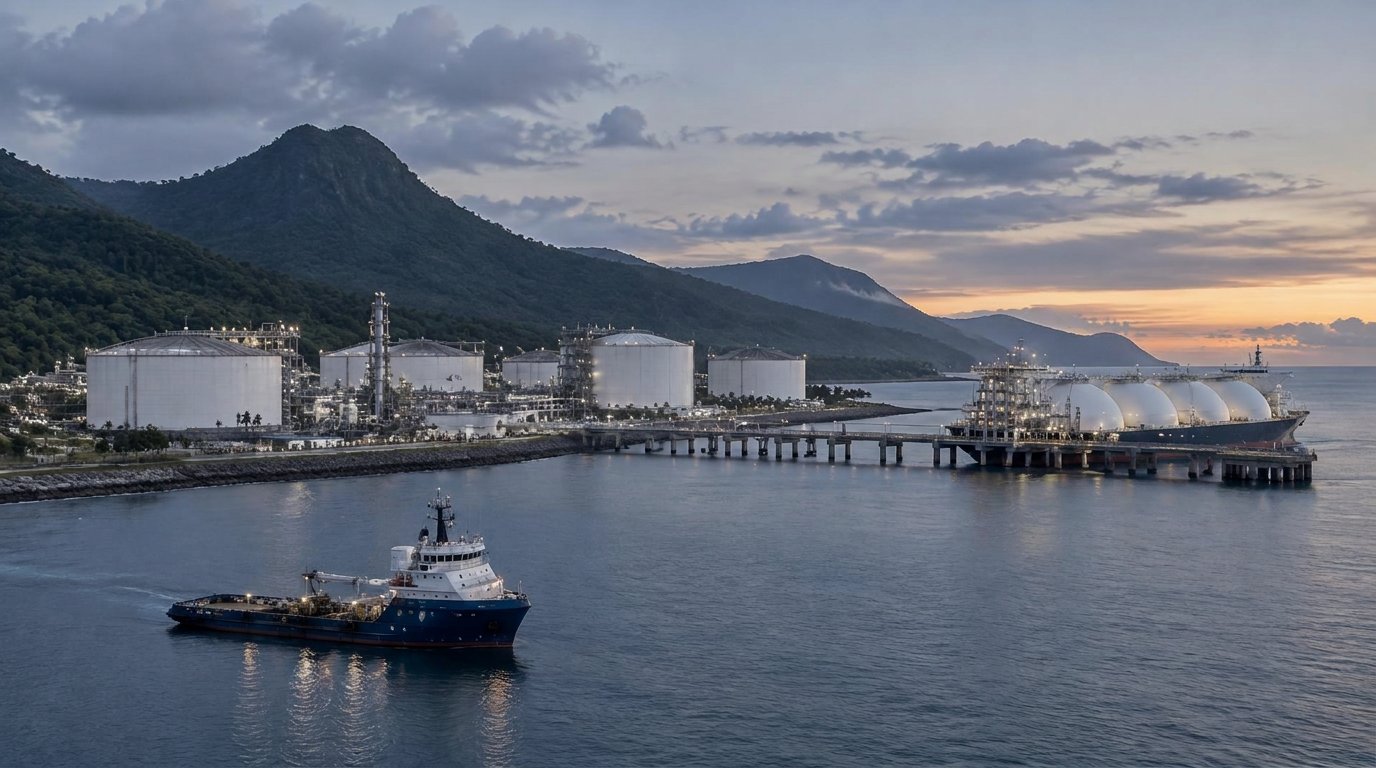
Central Africa
A mature producer reinventing itself around gas — Punta Europa is being rebuilt as a regional LNG hub. Ageing oil fields need redevelopment partners, and the state is actively looking for them.
Desk coverage from Cape Town and Stavanger
Saga's position in this market
Saga covers Equatorial Guinea from Cape Town and Stavanger through our intelligence system, partner network and travelling principals.
Sector deep dives — Equatorial Guinea
Equatorial Guinea covers 28,000 square kilometres, split between Bioko Island and the mainland Río Muni. It has 1.9 million people and a GDP of roughly $13 billion in 2025. It joined OPEC in 2017. Crude output has fallen to about 46,000 barrels a day, from a peak above 300,000 in 2004. GEPetrol is the oil NOC and Sonagas G.E. the gas NOC.
Alba gas built the Punta Europa complex on Bioko — LPG, methanol, power and, since 2007, EG LNG. The Gas Mega Hub is extending its life. Alen came on stream in 2021, Alba infill followed in 2025, and Chevron sanctioned the $690 million Aseng tieback in 2026, with first gas expected in 2028. Feed gas rises from about 175 to more than 300 million cubic feet a day. Yoyo-Yolanda, unitised with Cameroon, and Sonagas's EG-27 are the next backfill. On oil, GEPetrol took over Zafiro from ExxonMobil in 2024. A well-reconnection project should add 7,000–11,000 barrels a day, and the state is seeking partners to lift output above 50,000. Trident operates Block G (Ceiba, Okume), which produced about 20,400 barrels a day in 2025. Acreage is now awarded by direct negotiation; fewer than seven blocks remain open.
Equatorial Guinea remains a net fish importer despite rich waters. In June 2026 the government endorsed a fisheries study and moved to negotiate an industrial-fishing joint venture with a fisheries complex and shipyard. The AfDB-backed PASPA programme has opened a cold-chain complex at Bata. Luba Freeport on Bioko is the offshore supply base.
Oslo-listed Panoro Energy is the largest partner in Block G. It completed the purchase of Kosmos's 40.375 percent stake in June 2026, taking it to 54.625 percent, and it operates exploration blocks EG-01 and EG-23. That gives a Norwegian-listed company real weight in the country's most active brownfield.
Equatorial Guinea is a brownfield and gas-infrastructure market. Block G already runs workovers, ESP replacements and acid stimulations, and Zafiro needs reconnection and redevelopment. That suits low-capex well stimulation and subsea intervention. The Gas Mega Hub adds subsea tiebacks and the mainland LPG storage the minister has called for. The opportunity window is the next two to three years.
Saga connects Norwegian and Nordic technology and service providers with operators and national oil and gas companies, working through local partners. We are building our presence in Equatorial Guinea and provide market entry, commercial representation and technical due diligence.
Field intelligence · Equatorial Guinea
5 Nov 2026 · Equatorial Guinea
Read the analysis5 Nov 2026 · Equatorial Guinea · Offshore
Read the analysis5 Nov 2026 · Equatorial Guinea · Offshore
Read the analysis28 Oct 2026 · Equatorial Guinea
Read the analysisWorking on a project in Equatorial Guinea? We deliver Norwegian technology there, coordinated from Cape Town and Stavanger.
Talk to a partnerRelated markets — Central Africa
Continue across the geography
← Previous · Central Africa
Chad
Chad is covered by Saga's Central Africa partner, working with our Cape Town and Stavanger offices. Contact us for a briefing on current operator activity and local-content requirements.
Next · Central Africa →
Gabon
A mature deepwater and shelf oil province in managed decline. Perenco, Assala, TotalEnergies and BW Energy define the operator stack. Brownfield well-life extension is the dominant technical theme.
Start with a screening
Have a candidate well, asset or project in Equatorial Guinea? Send it to us and we will return a written screening within ten working days.