North Africa
Tunisia.
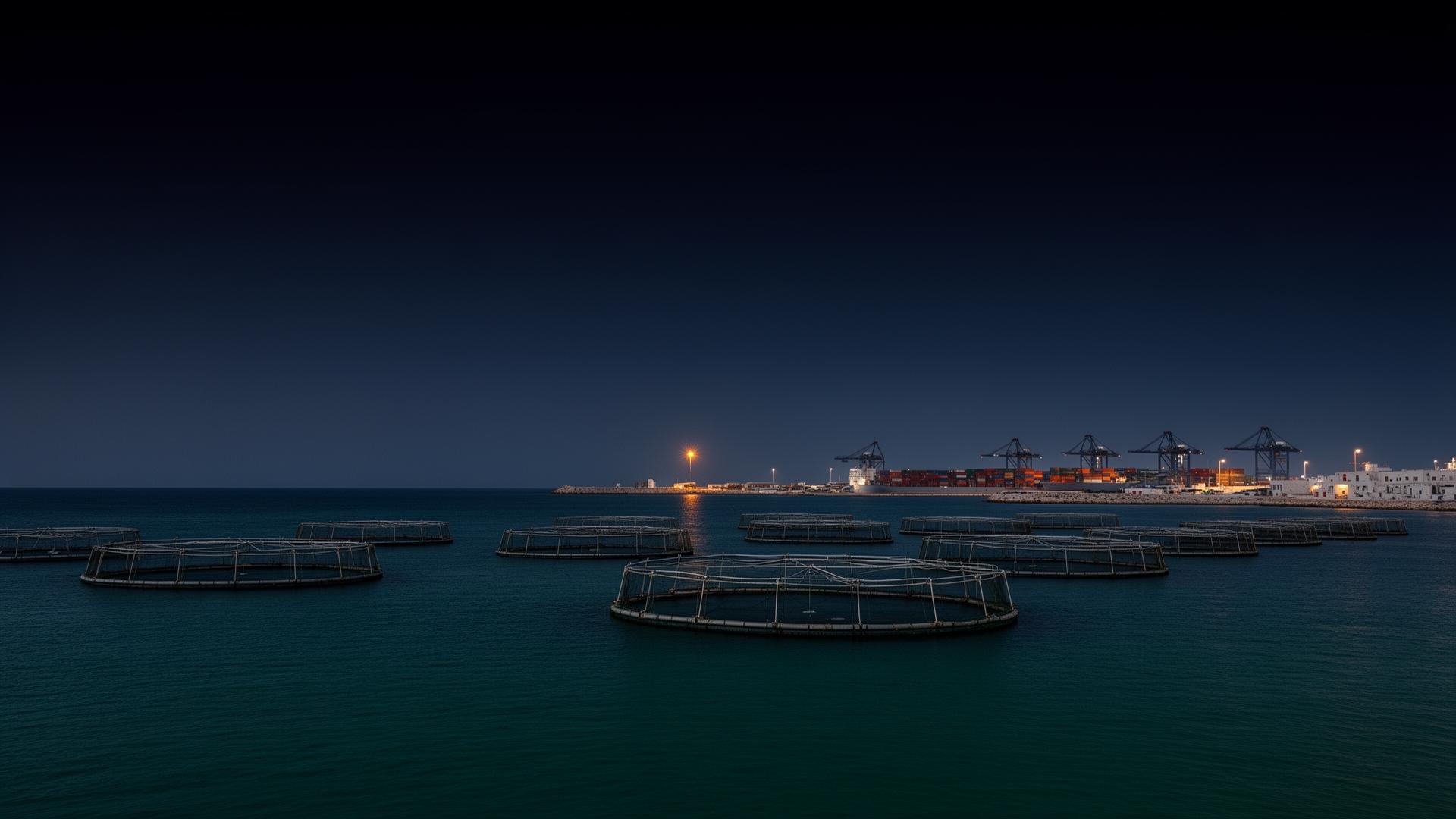
A country deliberately rebuilding outwards from the coast. Aquaculture inbound investment has accelerated sharply; the port-and-customs digitisation programme is one of the most coherent in North Africa. A focused, blue-economy entry point.
Desk coverage from Cape Town and Stavanger
Saga's position in this market
Saga covers Tunisia from Cape Town and Stavanger through our intelligence system, partner network and travelling principals.
Sector deep dives — Tunisia
The country today
Tunisia is a nation of 12 million people spanning 163,610 square kilometers. It has a diversified Mediterranean economy roughly $69 billion in GDP. Oil reserves are modest and steeply declining—1.4 billion barrels of oil, 0.4 tcf of gas. Production is collapsing relative to imports, forcing heavy dependence on Algerian gas pipelines and LNG.
The Mediterranean coastline is 1,298 kilometers. Port infrastructure is substantial (Port of Tunis, Sfax, Gabes). Fishing heritage is deep.
Currency depreciation has been steady. Petroleum sector contributes less than 3 percent of GDP. This is not a hydrocarbon economy anymore.
Political leadership under President Kais Saied is focused on economic diversification, digital transformation, and blue-economy development rather than hydrocarbon maximisation. That focus shapes everything.
The practical reason Saga is in Tunisia is not traditional brownfield upstream. It is aquaculture growth, port modernisation and fisheries surveillance.
Energy — oil and gas
Tunisia's proven oil reserves are 1.4 billion barrels; gas reserves are 0.4 tcf. Current production (2026) is approximately 27,000 barrels a day of oil and roughly 1.1 bcf a day of gas—both declining sharply year-on-year.
At first half 2025, oil production was down 8.8 percent year-on-year and met only 27.5 percent of domestic demand. Gas output has collapsed by almost 60 percent since peaking at 310 million cubic feet per day in 2010.
Gas import dependence hit 74.8 percent in first half 2025, with all imports supplied by Algeria via TransMed pipeline and spot LNG. Energy independence stood at 38 percent end-1H 2025. This is a net-energy-importer dynamic, not a technology-buyer opportunity for expanded production.
The Tunisian Company for Petroleum Activities (ETAP) is the state-owned NOC. All exploration acreage and production licenses flow through ETAP-led consortia with IOCs. The petroleum regulator is the Ministry of Energy, Mines and Green Transition. Fiscal regime is production-sharing contracts, with government take roughly 50–55 percent.
Eni (Italy) has significant operations via the Trans Tunisian Pipeline Company (TTPC) which transports Algerian gas through Tunisia, and operates production assets alongside ETAP. British Gas (BG, UK) operates the Miskar field, the largest natural gas field in Tunisia; production is declining. Panoro Energy (UK-listed independent) operates TPS Assets in the Sfax region with production in the 3,000–4,000 barrels-per-day range. OMV (Austria) maintains limited upstream presence and made a new discovery in the Sirte Basin (straddling Libya-Tunisia border) in late 2025.
Brownfield with decline: The Gulf of Gabes offshore fields are mature water-cut systems in terminal decline. Sfax onshore concessions are small producers with limited upside. There is no active exploration play or frontier acreage being shopped to majors. Recent activity is focused on slowing decline, not growth.
ETAP technical committees focus on lifecycle extension and cost reduction in existing assets. Panoro's capex is limited; technology decisions are opportunistic. Eni's TTPC is midstream/downstream; upstream tech evaluation is secondary.
Current operator focus is on legacy-field cost management rather than new-technology adoption; this may shift within a 3–5 year horizon.
The realistic near-term opportunities are: consultancy on ETAP's energy-import-substitution strategy (2026–2030); technology transfer and training for Miskar and TPS Assets lifecycle extension; and ad-hoc advisory on tight-gas development if OMV or another IOC secures southern Ghadames Basin acreage in 2026–2027.
Risks are structural. IOCs are exiting or downsizing Tunisia operations. Without a discovery or a regional gas pipeline to Europe, IOC technology investment will remain minimal. Algeria supplies all of Tunisia's imported gas; supply disruption would threaten energy security and IOC confidence. The Saied administration's priority is economic diversification, not hydrocarbon maximisation.
The blue economy
Tunisia has 1,298 km of Mediterranean coastline with historic fishing heritage. Capture fisheries remain significant but are subject to GFCM regulations and overfishing pressure. IUU fishing is a concern but lower than African peers.
Tunisia's aquaculture sector is growing and increasingly differentiated. As of 2024, production reached roughly 23,003 tonnes (up from 21,000 tonnes in 2022), valued at $106 million USD annually. The government has set an ambitious target to grow aquaculture output by 52 percent by 2030, lifting production to roughly 35,000 tonnes. This is a multi-year growth trajectory with real capex momentum.
Farmed species: European sea bass and gilthead sea bream dominate at 96 percent of production; Atlantic bluefin tuna fattening and Mediterranean mussels in Bizerte Lagoon are secondary.
The sector employs roughly 3,000 workers. Approved investment in 2024 was up sevenfold from 2023, with momentum continuing into 2025.
Challenges: 50 percent of fish feed is imported. 80 million fry are sourced abroad. Technology-transfer partnerships with Norwegian or European cage-system and feed-tech suppliers are undersaturated—a clear Saga opportunity.
Port infrastructure: Port of Tunis (Rades) handles roughly 500,000 TEU annually—the largest containerised cargo hub in Tunisia. The Ministry of Transport is assessing digital expansion options for the container terminal. Sfax, Gabes, and Rades ports are being evaluated for digital transformation under Tunisia's 2025–2026 digital-infrastructure programme.
Tunisia ranks third continent-wide and first in North Africa for e-government (UN E-Government Survey 2024), suggesting institutional readiness for port-logistics digitisation.
The aquaculture growth target combined with real capex momentum, import dependency, and lack of Norwegian/Nordic technology partnerships creates a clear opportunity for Saga to position as an aquaculture-tech enabler. Port-logistics digitisation is a secondary angle.
The Norwegian–Tunisia corridor
Tunisia and Norway maintain formal diplomatic relations. Norway has no resident embassy in Tunis; diplomatic affairs are handled by the Norwegian embassy in Algiers, with an honorary consulate in Tunis. Tunisia is not currently a Norwegian development-cooperation priority country.
Norwegian operators have no upstream acreage or operations in Tunisia.
If Saga positions Tunisia as a blue-economy / aquaculture market and partners with Norwegian or Nordic aquaculture companies (with feed-tech or genetics capabilities), bilateral fisheries-development cooperation could open doors.
The EU is the dominant actor. France, Italy, Germany are principal trading and investment partners. EU Global Gateway projects in Tunisia focus on renewable energy, digital-infrastructure funding, and fisheries reform. Sweden, Denmark, Finland maintain minimal presence.
China-Tunisia trade has grown steadily. Chinese BRI projects underway include the International Diplomatic Academy and a university hospital in Sfax. Tunisia signed a free-trade agreement with Turkey (2024).
Tunisia is a signatory to the African Continental Free Trade Area, African Union, Union for the Mediterranean, and WestMED Initiative. It is also a GFCM member, giving it voice in Mediterranean fisheries governance.
If Saga expands into aquaculture advisory and blue-economy digital services, Tunisia's WestMED participation, aquaculture growth target, and EU funding pipelines create a leverage point.
What Saga sees
Tunisia's hydrocarbon era is closing. Production has fallen 60 percent in a generation. Import dependence is structural. IOC interest is waning.
Tunisia is building its next economy—aquaculture, digital infrastructure, export-oriented food security, port modernisation. The government is investing. Investment is accelerating. Norwegian and Nordic aquaculture technology—genetics, feed formulation, cage systems, operational excellence—is in demand but undersupplied.
The Port of Tunis (Rades) is a regional hub undergoing digital transformation. Port-logistics tools and supply-chain visibility systems have a receptive customer. Tunisia ranks first in North Africa for e-government readiness. That readiness extends to port operations.
The window is open for the next 18–24 months.
How we work in Tunisia
Saga's representation in Tunisia is built around active commercial dialogue with the relevant ministries and the trajectory of aquaculture investment.
We provide market entry for Norwegian principals, commercial representation, due diligence, ministry liaison, deal structuring, and on-the-ground project management. We position Norwegian blue-economy and digital expertise as aligned with Tunisia's 2026–2030 national development plan—not as a narrowly oil-and-gas pitch.
If your company is considering Tunisia's aquaculture or port-modernisation opportunities, talk to us before you invest.
At a glance
- Population: 12 million
- GDP: $69 billion (2024–2025 estimate)
- Hydrocarbons: Oil 1.4 bn barrels (declining); Gas 0.4 tcf (declining, import-dependent)
- Principal NOC: Tunisian Company for Petroleum Activities (ETAP)
- Norwegian footprint: No resident embassy (accredited from Algiers) · honorary consulate Tunis · limited energy partnerships · WestMED participation opens EU-led blue-economy doors
- Saga focus areas: Aquaculture expansion advisory and tech-transfer facilitation · Port of Tunis (Rades) modernisation · Fisheries surveillance via WestMED · Energy-security strategy consultancy
Live intelligence — Tunisia
Track deals, operator moves and regulatory signals for Tunisia on Saga's intelligence platform.
Related markets — North Africa
Continue across the geography
Start with a screening
Have a candidate well, asset or project in Tunisia? Send it to us and we will return a written screening within ten working days.