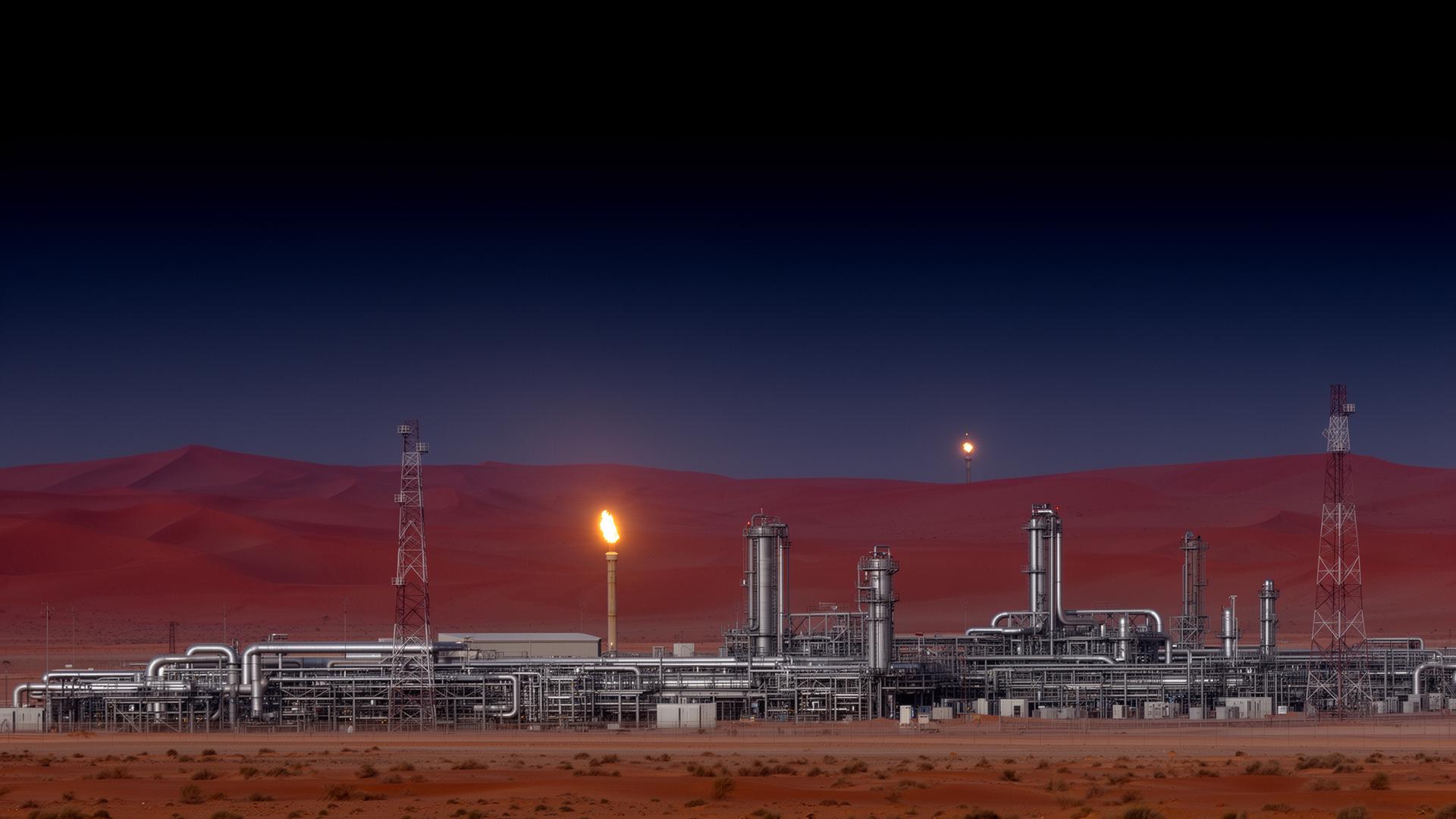
North Africa
Algeria.
Sonatrach's 2025–2030 well plan is one of the largest in the world. Gatekept and slow but deeply rewarding for principals who arrive with a credible regional partner. Hassi Messaoud and Hassi R'Mel are canonical tight-carbonate plays.
Desk coverage from Cape Town and Stavanger
Saga's position in this market
Saga covers Algeria from Cape Town and Stavanger through our intelligence system, partner network and travelling principals.
Sector deep dives — Algeria
The country today
Algeria spans 2.38 million square kilometers across North Africa. It is a nation of 45 million people with a hydrocarbon-dependent economy roughly $233 billion in GDP. Oil reserves stand at 12.2 billion barrels; gas reserves at 2.4 trillion cubic feet. These numbers rank Algeria among Africa's and OPEC's resource elite.
The Mediterranean coast runs 998 kilometers. Algeria controls 1,600 kilometers of territorial sea and 2.56 million square kilometers of exclusive economic zone. But the ocean is secondary to the onshore hydrocarbon wealth and the Saharan basins where production actually lives.
Sonatrach—the state NOC—is vertically integrated and gatekeeps all upstream acreage. Political leadership under President Abdelmadjid Tebboune treats hydrocarbon policy as a sovereign matter. Partnerships with foreign operators are managed through PSC terms and local-content rules.
The practical reason Saga is in Algeria: Hassi Messaoud and Hassi R'Mel are archetypes for tight-carbonate, high-water-cut, declining-productivity plays. Sonatrach has openly identified shale and tight-gas development as essential to offset conventional decline. The technology window is open.
Energy — oil and gas
Algeria's proven oil reserves are roughly 13.2 billion barrels—a 27- to 30-year reserve life at current production. Gas reserves are 2.4 tcf, with Hassi R'Mel and In Salah/In Amenas being the legacy giants.
Current production (2026) is approximately 1.0 million barrels a day of oil and 8.8 bcf a day of gas. Both trajectories are declining. Hassi Messaoud, the flagship onshore field, delivers around 450,000 barrels a day with water cut rising to 35 percent. Gas production is also declining as Hassi R'Mel and other mature carbonate reservoirs water out.
Sonatrach outlined a 2025–2030 investment plan to drill nearly 1,450 oil wells, restarting programmes deferred during COVID. The stated goal is to stabilise oil output through 2027 via horizontal infill drilling and electric submersible pump upgrades—both adjacent to Saga's technology focus.
Sonatrach is the exclusive upstream operator. All exploration acreage, production licences, and development rights flow through Sonatrach-led consortia. The Ministry of Energy and Mines sets fiscal terms and production quotas. The fiscal regime is production-sharing contracts, with government take typically 50–60 percent depending on field maturity and crude quality.
Eni (Italy) operates In Amenas and In Salah—two of Algeria's largest gas fields—alongside Sonatrach and a Norwegian operator partner. In February 2023, Eni closed the acquisition of BP's 50 percent stake. In July 2025, a PSC for Zemoul El Kbar included a planned $1.35 billion investment. The Norwegian operator partner has held a continuous Algeria position for nearly three decades. BP (UK) exited operatorship in February 2023 when it sold operations to Eni, though it retains minority interests in historical JVs. CNPC (China) is building upstream presence with exploration focus.
Brownfield dominance is absolute: 90 percent or more of current production derives from fields more than twenty years old. Hassi Messaoud–Dahar province contains roughly 71 percent of Algeria's combined proved, probable, and possible reserves. These sandstone pays are mature, with water cut at 35–50 percent in main structures. Hassi R'Mel (gas) is in terminal decline. Sonatrach has explicitly identified shale and tight gas as essential to backfill the conventional decline.
The Grand Erg/Ahnet Basin holds roughly 80.1 tcf of technically recoverable shale gas according to USGS 2026 assessment. However, shale-gas development in Algeria remains pre-commercial. Drilling and completion costs run high relative to downstream gas prices. Sustained investment from Sonatrach remains uncertain.
ALNAFT (Algeria's independent regulator) is relaunching exploration licensing in early 2026 following a strategic pivot toward non-conventional resources. Frontier blocks in the Sahara onshore and offshore Mediterranean pre-Messinian areas are being shopped to majors, but subsurface risk is high.
Sonatrach's technical committees directly evaluate well-completion, stimulation, and artificial-lift technology through R&D partnerships and vendor workshops. Sonatrach is deploying artificial-lift upgrades and selective EOR pilots on Hassi Messaoud to maintain output. Eni (operator in In Salah and In Amenas) has significant deepwater and mature-field experience and is a steady buyer of third-party completion and intervention services. The Norwegian operator partner is held to high technology standards, but decisions flow by consensus with Eni and Sonatrach—a slow process.
The realistic near-term opportunities are: Hassi Messaoud horizontal infill and multilateral completion programmes (Sonatrach's well plan targets incremental barrels from brownfield assets; mechanical multilateral stimulation can address thin-pay, heterogeneous-carbonate geometry — entry requires a local Algerian partner or a proven European operator relationship); tight-gas exploration in Grand Erg/Ahnet basin if the early-2026 licensing round attracts an aggressive IOC; and consultancy on Sonatrach's 2030 brownfield-optimisation roadmap as a footing for future tech pilots.
Risks are material. Sonatrach requires in-country technical presence, local-content spending, and technology-transfer clauses in vendor contracts. Shale-gas economics remain unproven at scale.
The blue economy
Algeria has a 1,600 km Mediterranean coastline and 2.56 million square kilometers of exclusive economic zone. However, capture fisheries are modest compared to West African states. The Mediterranean fishery is heavily regulated by GFCM (General Fisheries Commission for the Mediterranean) and overfished for decades. No dominant artisanal fleet. IUU exposure is moderate.
Aquaculture is nascent. Algeria currently produces almost 1,000 tonnes of freshwater cyprinids and very limited marine fish. The government has set a target of 50,000 tonnes by 2030 under the National Blue Economy Strategy (SNEB-2030). This is a long-cycle opportunity, not a near-term one.
Algeria participates in the WestMED Initiative—a multinational framework involving France, Italy, Portugal, Spain, Malta, and five southern Mediterranean countries. Technical assistance from EU and international partners is available, but investment is slow.
Port infrastructure (Algiers, Oran, Annaba, Bejaia, Skikda) handles breakbulk and LNG traffic. Skikda is an LNG export hub. Offshore wind potential is negligible. Decommissioning activity is non-existent.
The blue economy in Algeria is a long-cycle play. Aquaculture growth is capital-dependent on EU and World Bank funding, and progress has been slow.
The Norwegian–Algeria corridor
Norway maintains a resident embassy in Algiers. Algeria is not currently a priority bilateral partner in Norwegian development cooperation strategy.
A Norwegian operator's continuous presence in In Salah and In Amenas is the principal industrial connection. That presence is embedded in established JVs and decisions on new partnerships or service vendors flow by consensus among multiple operator partners.
The EU is the dominant external actor. France, Italy, Spain are the principal EU partners. EU Global Gateway projects in Algeria concentrate on renewable energy and digital-infrastructure grants, not traditional O&G. Sweden, Denmark, Finland maintain minimal current O&G presence.
Chinese investments and contracts in Algeria have grown significantly, including flagship infrastructure projects. PowerChina is constructing solar-plant capacity in Biskra. Chinese companies lead Algeria's solar build-out.
Russia maintains a steady relationship on military, energy and OPEC+ matters. Turkey has signed an MOU with Sonatrach on green-hydrogen production for green-steel manufacturing and signed a free-trade agreement in 2024.
Algeria is a founding OPEC member and an active OPEC+ participant. It is a signatory to the African Continental Free Trade Area and participates in the African Union.
Saga's best path is to position Norwegian completion technology as ESG-grade, water-handling, emissions-reduction-focused capability that aligns with Sonatrach's own brownfield sustainability messaging.
What Saga sees
Hassi Messaoud and Hassi R'Mel are classic tight-carbonate, high-water-cut, mature-field exemplars. Sonatrach's drilling plan and explicit acknowledgment of shale/tight-gas as a strategic hedge both signal technology-buyer appetite. Sonatrach's centralised technical decision-making processes require engagement at the corporate level and shape the realistic entry path.
The realistic near-term play is a consultancy engagement on brownfield-optimisation strategy—a gateway to future tech pilots. A second path is a partnership with an established in-country service provider.
A short engagement with a Western JV partner's Algeria asset team to assess completion-technology gaps in the existing operations is the warmest available pathway. A Sonatrach Strategic Planning consultancy on a Hassi Messaoud roadmap would position Saga as a trusted independent advisor and generate follow-on technology and piloting opportunities.
Shale-gas development support is a 2026-Q4 / 2027 conversation if ALNAFT's licensing round succeeds.
How we work in Algeria
Saga's representation model covers Algeria through our relationships with operators in the country and our understanding of Sonatrach's structure and the tempo of decision-making.
We provide market entry for Norwegian principals, commercial representation, due diligence, ministry liaison, deal structuring, and on-the-ground project management. We know that in Algeria, entry requires patience and credible local partnership.
If your company is considering Algeria, talk to us before committing resources.
At a glance
- Population: 45 million
- GDP: $233 billion (2024–2025 estimate)
- Hydrocarbons: Oil 12.2 bn barrels; Gas 2.4 tcf
- Principal NOC: Sonatrach
- Norwegian footprint: Embassy Algiers · long-standing Norwegian operator partnership in In Salah/In Amenas · historical Norad cooperation
- Saga focus areas: Hassi Messaoud brownfield optimisation · Western JV partner technology-gap analysis · Sonatrach 2030 strategy consultancy · Tight-gas development support (2027+)
Live intelligence — Algeria
Track deals, operator moves and regulatory signals for Algeria on Saga's intelligence platform.
Related markets — North Africa
Continue across the geography
← Previous · North Africa
Egypt
Africa's largest energy market and the home of our most cited brownfield reference. Western Desert tight-carbonate work is live; Cairo is the right place to start a Mediterranean-and-Africa BD calendar.
Next · North Africa →
Libya
The single most consequential brownfield opportunity on the continent. The Sirte Basin holds Africa's largest reserve cluster; the recent licensing round has put NOC and Mellitah back in conversation with foreign capability. We treat the security picture honestly and we are present.
Start with a screening
Have a candidate well, asset or project in Algeria? Send it to us and we will return a written screening within ten working days.