Southern Africa
Namibia.
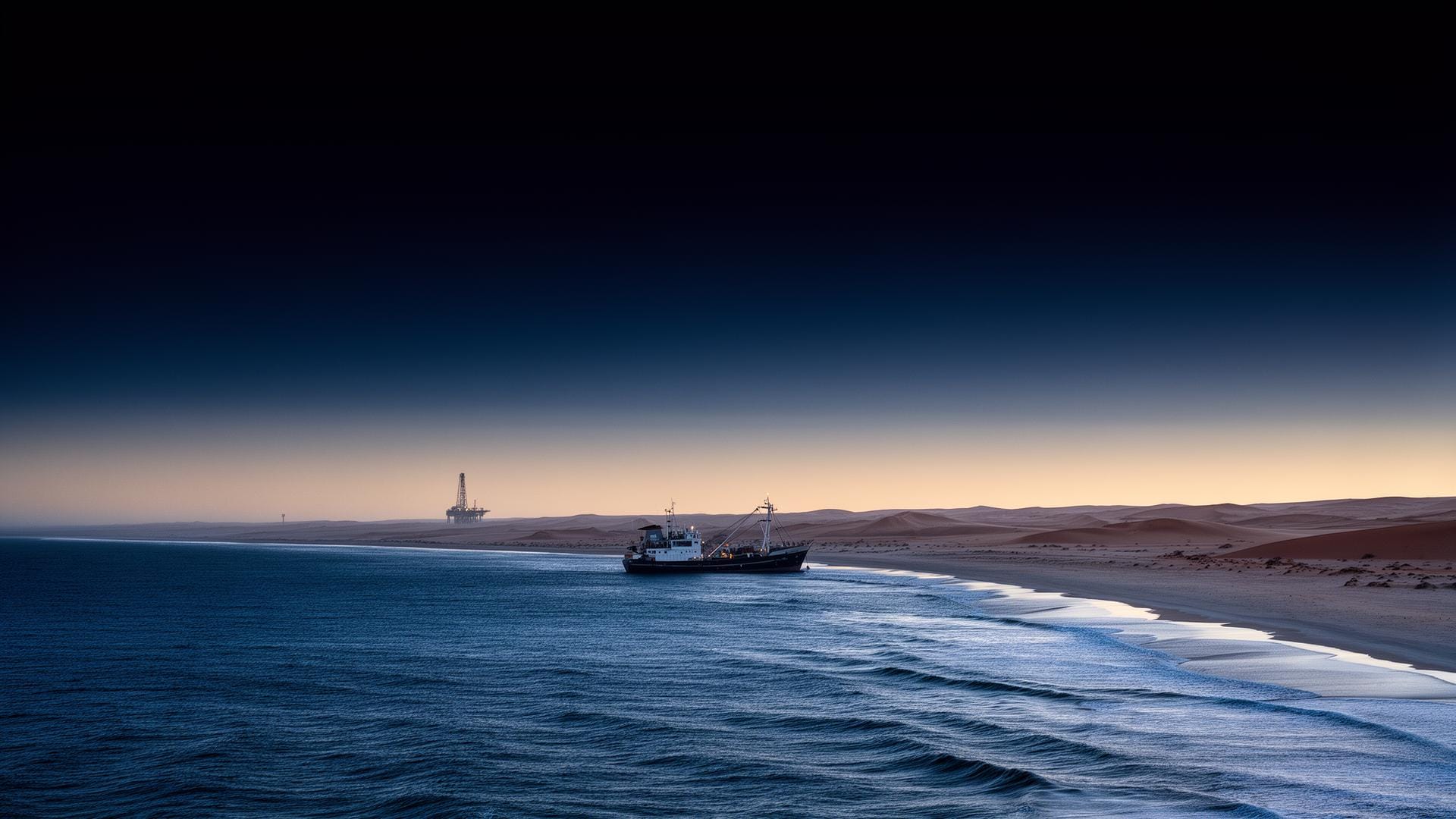
Africa's most-watched frontier story is now a development story. Venus, Mopane, Graff, Jonker and Sapakara are sequencing toward FID. Lüderitz and the hake industry connect the energy story to a long-standing Norwegian-Namibian fisheries relationship.
Desk coverage from Cape Town and Stavanger
Saga's position in this market
Saga covers Namibia from Cape Town and Stavanger through our intelligence system, partner network and travelling principals.
Sector deep dives — Namibia
The country today
Namibia is a lower-middle-income nation of around 2.7 million people. Until 2022 it had no commercial oil production. Today, it is on a path to becoming a hydrocarbon exporter and, over the next decade, a meaningful producer if development proceeds on schedule. The political moment is stable. The regulatory environment is clear. The technology buyers are global majors with FID timelines measured in months, not years. That confluence — geological fortune, administrative clarity, operator capital certainty — is rare in African oil markets.
The discoveries are substantial. The Orange Basin, offshore Namibia's central coast, has emerged as a global frontier play with a string of discoveries since 2022 and aggregate discovered resources well into the multi-billion-barrel range. Three anchors define the development agenda: TotalEnergies' Venus, Shell's Graff and Jonker, and Galp Energia's Mopane. TotalEnergies is targeting an FID for Venus and first oil later this decade. Mopane is a major discovery in active development planning, with FID later in the decade after recent farm-in activity. Shell is preparing to drill further exploration wells on the Graff and Jonker blocks. None of these operators is hedging.
Energy — oil and gas
This is not brownfield Angola. It is frontier. Every well drilled in the Orange Basin carries exploration uncertainty. The rocks are not as well understood as Angolan analogues. The pressure regimes are narrow — sub-normal to above-normal across short vertical intervals — and they demand precision in wellbore design and drilling execution. The subsea infrastructure required does not yet exist in Namibia. No FPSOs have been built or installed locally. No fixed platforms operate offshore. Namibia's last commercial offshore oil activity was decades ago.
The regulatory frame is among the cleanest in Africa. NAMCOR, Namibia's national petroleum company, holds equity stakes in major blocks and acts as both operator and co-regulator. The Ministry of Mines and Energy licenses petroleum-exploration blocks on a competitive basis; fiscal terms are transparent. PSC terms are credible and durable. What matters more is speed: NAMCOR approvals for drilling and development proposals typically complete within months rather than years. That ability to move at operators' pace is a competitive advantage that will only matter more as FIDs lock in.
Venus economics depend on FID being reached on schedule. TotalEnergies has committed personnel, capital and rig time across a multi-well, concurrent drilling campaign. Smaller equity holders in adjacent acreage have signalled willingness to license third-party well-design and drilling-services optimisation. Galp, after the recent equity reshuffle, is in active development planning for Mopane. Shell is on exploration timelines but has clearly stated drilling intent. These are frontier operators with global deepwater expertise, and they are moving at speed.
The technology gap is not in reservoir characterisation or field-development planning. It is in the execution of subsea systems in narrow-margin pressure windows, in high-angle wells and in weak shale sequences. Subsea completion systems, well-design optimisation, managed-pressure drilling and FPSO hook-up engineering are where vendor differentiation will be captured. The earliest appraisal wells on Venus and Mopane are being drilled now and through the next two years. A vendor that can demonstrate safety, repeatability and cost reduction in these domains will gain pilot traction in the medium term and commercialisation around first oil.
The blue economy
Namibia's hake fishery is among Africa's most productive and most rigorously managed. The total allowable catch for hake is set under sustainable management; it was the first African fishery to receive Marine Stewardship Council certification. The industrial fleet is dominated by large trawlers under long-term access agreements. Foreign companies operate under Namibian licensing and contribute substantially to export revenue. The fishery contributes a meaningful share of GDP and supports many thousands of direct jobs in landing, processing, logistics and supply-chain services. Artisanal and small-scale fishing employs additional thousands.
Lüderitz and Walvis Bay concentrate most of Namibia's seafood-processing facilities. Both are becoming strategic infrastructure assets as oil-and-gas development accelerates. Walvis Bay is the principal deep-water port, handling container, general cargo and bulk commodities. Lüderitz is specialised in fishing, processing and small-vessel maintenance. Both are undergoing expansion to accommodate offshore-energy supply-chain demand.
Aquaculture is emerging at pilot scale. Oyster cultivation in sheltered lagoons exports to Asia and South Africa. More significant is a Norwegian-backed land-based salmon-farming operation under development northwest of Lüderitz, currently in pilot phase with planned commercial-scale capacity at full build-out. Its success depends entirely on Norwegian technology transfer and sustained capital commitment.
The intersection of oil-and-gas infrastructure and fisheries is now material. Subsea cables, FPSO offloads and rig operations will operate in hake-fishing zones; collision risk, subsea-clearance protocols and fleet coordination will demand active governance. Port modernisation at Walvis Bay and Lüderitz is a 24-to-36-month advisory opportunity for Saga where the principal is moving supply-chain logistics or port-concession structuring. Fisheries surveillance and IUU enforcement are contingent on government capacity and donor funding.
The Norwegian–Namibia corridor
Namibia's Norwegian footprint is modest but growing. Equinor has no current operating equity in Namibia but has been mentioned as a potential technical advisor in prior years and retains deepwater expertise that Namibian operators value. BW Energy, the Norwegian independent, has deep West African ultra-deepwater experience and has stated exploratory interest in Orange Basin acreage.
Norwegian development cooperation operates a modest bilateral programme focused on infrastructure, education and fisheries governance. Norway has no resident embassy in Namibia; diplomatic affairs are handled by the Norwegian embassy in Pretoria, with an honorary consulate general in Windhoek. Trade relationships exist through legacy Statoil-era ties and Equinor supply-chain partnerships with local logistics firms.
The introduction path for a Norwegian technology principal is less defined than in Angola. It depends on whether Equinor engages as a technical advisor on Shell or other blocks, and on building relationships with NAMCOR and operators directly. This is not a weakness; it is different. Namibia is pro-business. The regulatory environment moves fast. A vendor with a credible technical proposition and the capital to pilot it does not need a legacy relationship to gain operator attention.
Sweden and Denmark maintain presence through trade houses and fishing-company partnerships. Finland is minimal. The EU identifies Namibia as a strategic infrastructure partner for southern Africa. The UK maintains diplomatic representation but limited energy-sector engagement. Portugal retains cultural ties through former colonial links. China has substantial mining investment but has been less prominent in upstream oil and gas. Qatar Energy is a material Gulf participant with significant Orange Basin equity.
What Saga sees
Namibia is frontier exploration transitioning to first-oil development. Brownfield decline-rate management does not apply here. The inverse opportunity is material: TotalEnergies, Shell and Galp are compressing appraisal and development timelines on high-risk subsea systems, and a technology vendor offering well-design optimisation, completion innovation or managed-pressure drilling services will gain pilot traction on Venus or Mopane appraisal wells over the medium term. NAMCOR, as an equity partner, is upgrading its subsea engineering and asset-management capability and will be a willing co-buyer.
Namibia's pro-business, stable political environment and supportive regulatory climate are not incidental — they are the foundation. Operator decision-making is not hostage to ministry delays or fiscal reinterpretation. That clarity enables capital commitment and accelerates technology adoption. A vendor moving into Namibia should expect to be challenged on technical merit and cost, but not on political risk or approval timelines.
The adjacent plays are medium-term. Aquaculture — the Norwegian-backed land-based salmon-farming pilot — is a 24-to-36-month engagement. Port modernisation at Walvis Bay is a 24-to-36-month advisory opportunity tied to FPSO supply-chain logistics. Fisheries surveillance is contingent on government capacity-building and donor funding.
AI and digital systems are moving at the same pace as in Angola — early adoption by international operators, government strategy documents, nascent implementation. The market window is narrower than Angola's because Namibia is moving faster.
The diplomatic channel is secondary. A credible vendor with technical substance and the capital to pilot does not require legacy relationships to gain operator attention.
How we work in Namibia
Saga covers Namibia from our Cape Town and Stavanger desks, with regular travel to Windhoek. Our relationships with NAMCOR and with operator technical teams on active Orange Basin blocks are built on that corridor, and we follow the development timelines closely. We offer market entry support, commercial representation of technology vendors, technical due diligence, ministry liaison and project management of pilot drilling campaigns. We are early into this market, but we are moving at its pace. If a Norwegian principal wants to participate in the next global frontier, Namibia is the clearest entry point in Africa today.
At a glance
- Population: ~2.7 million
- Hydrocarbons: Frontier crude oil; substantial discovered resources across the Orange Basin
- Principal NOC: NAMCOR
- Norwegian footprint: No resident embassy (accredited from Pretoria) · honorary consulate general Windhoek · Equinor (potential technical advisor) · BW Energy (exploratory interest) · modest bilateral programmes · legacy supply-chain relationships
- Saga focus areas: Subsea completion and well-design optimisation for ultra-deepwater Orange Basin systems · Managed-pressure drilling for narrow-margin pressure windows · FPSO hook-up engineering · NAMCOR capacity-building on digital asset management
Live intelligence — Namibia
Track deals, operator moves and regulatory signals for Namibia on Saga's intelligence platform.
Related markets — Southern Africa
Continue across the geography
← Previous · West Africa
Mauritania
Mauritania is covered by Saga's West Africa partner network, working with our Cape Town and Stavanger offices. Contact us for a briefing on current operator activity and local-content requirements.
Next · Central Africa →
Republic of the Congo
The cleanest commercial read in central Africa. TotalEnergies on Moho Nord, Eni's Marine XII LNG ramp-up to 3 mtpa, Perenco's shelf — three named operators and a clear push to 500 kbpd.
Start with a screening
Have a candidate well, asset or project in Namibia? Send it to us and we will return a written screening within ten working days.