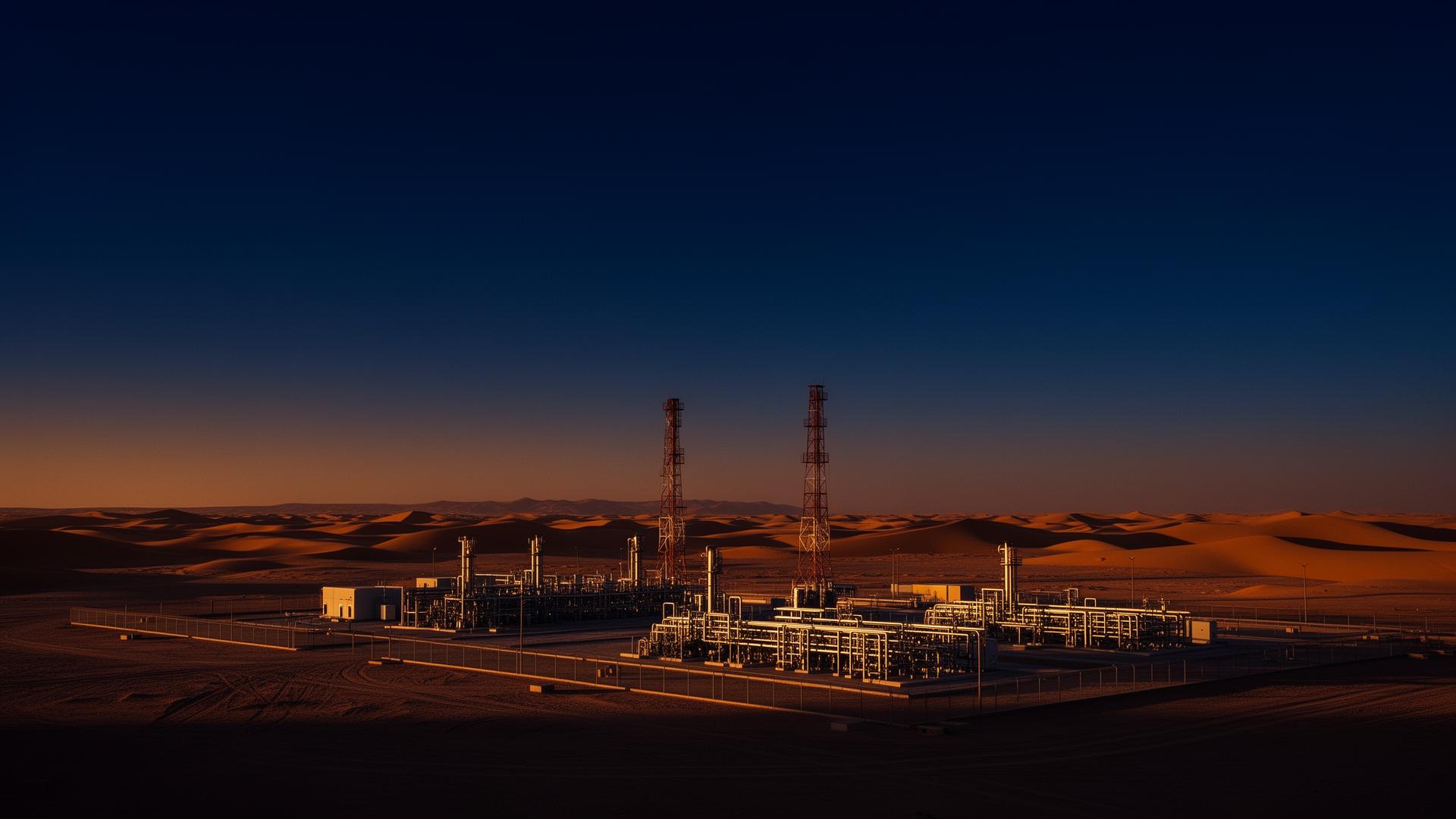
North Africa
Egypt.
Africa's largest energy market and the home of our most cited brownfield reference. Western Desert tight-carbonate work is live; Cairo is the right place to start a Mediterranean-and-Africa BD calendar.
Desk coverage from Cape Town and Stavanger
Saga's position in this market
Saga covers Egypt from Cape Town and Stavanger through our intelligence system, partner network and travelling principals.
Sector deep dives — Egypt
The country today
Egypt is a nation of 104 million people anchored on the Nile Delta. Its economy—roughly $443 billion in GDP—is as much about trade and tourism as it is about energy. The Suez Canal alone brings in $7.5 billion annually (a figure that climbed back to $449 million in just the first quarter of 2026 after years of disruption). President El-Sisi has kept energy policy remarkably steady. The currency has depreciated, but the petroleum sector runs on dollars.
What matters for Saga: Egypt has Africa's most mature oil and gas sector and an operator community actively evaluating foreign completion technology. That is why we are here.
Energy — oil and gas
Egypt's proven reserves sit at 3.4 billion barrels of oil and 2.2 trillion cubic feet of gas. Current production is roughly 700,000 barrels a day of oil and 4.2 billion cubic feet a day of gas. That gas should be enough. It is not. Domestic demand runs to 6.2 bcf/day, leaving a structural 2 bcf/day import gap. Israel's Chevron-operated Leviathan field (a $35 billion deal signed in August 2025) is now supplying Egyptian LNG. This is the shape of Egypt's energy future: managing decline in legacy fields while importing gas to close the gap.
The backbone of Egyptian oil and gas is age. Roughly 85 percent of production comes from fields more than twenty years old: the Western Desert, the Gulf of Suez, and the Nile Delta. These are Saga's territory. Water cut is rising. Decline rates run 5 to 15 percent per year. The pays are thin, heterogeneous, and water-sensitive. They sit in tight carbonates.
The international operator base alongside the state NOC (Egyptian General Petroleum Corporation) includes Shell (via its Bapetco joint venture with EGPC), Apache (through the Khalda Petroleum joint venture in the Western Desert), and Eni, with Chevron, Wintershall, Dragon Oil and GUPCO in secondary roles in the Gulf of Suez and Sinai. Bapetco is the reference brownfield-technology operator in Egypt and clears capital quickly. Apache's Khalda received new Western Desert blocks in October 2025 with a near-term drilling commitment. Eni announced in November 2025 a multi-billion-dollar investment to extend the life of legacy Sinai and Nile Delta assets.
The work is visible in the field. Operators in Egypt are openly discussing AI-enhanced brownfield production. Eni's commitment explicitly targets "extending life of legacy assets" and "short-cycle, infrastructure-led upstream projects." These are exact descriptions of brownfield work.
The technical opportunity is sharp. Horizontal drilling is moving into the Western Desert. Tight-carbonate stimulation, water-disposal engineering, and completion design are the bottlenecks. Operators' technical committees are evaluating foreign completion vendors. The NOC (EGPC) cleared significant outstanding partner payments by mid-2026. Permitting for brownfield recompletion and small infill wells is relatively fast.
In the next 12 to 24 months, the live themes are: tight-carbonate stimulation programmes in Western Desert acreage—candidates for multilateral, multi-stage mechanical stimulation; Eni's Sinai and offshore Nile Delta revitalisation, which will require well-intervention, stimulation and EOR advisory; and brownfield AI-driven production optimisation initiatives signalling appetite for real-time reservoir surveillance and artificial-lift optimisation.
The blue economy
Egypt is Africa's leading aquaculture producer. In 2024, it farmed 1.6 million tonnes of fish—67 percent of the continent's aquaculture output—and generated $3.5 billion in value. Tilapia comprises 75 percent of that production; Egypt is the world's second-largest tilapia farmer. Roughly 300,000 people work in the sector. The Red Sea and Mediterranean support modest artisanal fleets, but 80 percent of Egyptian fish production is farmed.
Feed inputs and fry sourcing remain import-dependent. Climate change—specifically Nile low-flow risk and Red Sea salinity shifts—poses secondary threats.
The Suez Canal is Egypt's maritime cornerstone. In the first quarter of 2026, 1,315 vessels transited, generating $449 million in revenue. Port infrastructure in Alexandria, Port Said, Suez, and Damietta handles container, breakbulk, and RoRo cargo. Offshore wind is nascent; Egypt targeted 42 percent renewables by 2030, but that is mostly onshore solar.
Blue economy and oil-and-gas operate in separate lanes in Egypt. Aquaculture is a food-security lever, not an offshore-service ecosystem. Decommissioning potential exists for mature offshore Nile Delta platforms, but no commercial subsea-service corridor has yet formed.
The blue economy is a conversation for future expansion, not a near-term driver.
The Norwegian–Egypt corridor
Egypt and Norway maintain formal diplomatic relations. Norway operates a resident embassy in Cairo and an honorary consulate general in Alexandria. Norway's Ministry of Foreign Affairs lists Egypt as a partner in water, renewable energy, and governance cooperation.
International operators in Egypt have publicly highlighted the value of Norwegian and Nordic service-sector technologies for brownfield work. Norwegian completion and stimulation capability is well aligned to the Western Desert and Gulf of Suez asset base.
The EU dominates Egypt's investment landscape. Eni, BP, and Wintershall are major players. China is active in renewable energy and planning a battery factory in the Suez Canal Economic Zone. Saudi Aramco holds upstream exploration interests. QatarEnergy holds 23 percent of the North El-Dabaa offshore block. Turkey operates renewable-energy and logistics companies in Egypt.
Egypt is a founder member of OPEC+ (it left OPEC in 2016). It is also a signatory to the African Continental Free Trade Area and the African Union.
What Saga sees
Egypt is the production anchor of North Africa. The operators are not replacing their reserves; they are maximising the life of the fields they have. Water cut is climbing. Well count is rising. Completion complexity is increasing. The major operators in the country are all active buyers, and Eni's investment commitment is the signal—a European major is betting that brownfield revitalisation, not greenfield exploration, is Egypt's energy story for the next several years.
Norwegian completion and stimulation technology fits this moment tightly. The NOC is fiscally improving. Western energy-tech principals face competition from Chinese and Turkish renewable-energy companies, not from traditional upstream-completion vendors.
The realistic opportunity is a pilot in tight-carbonate stimulation followed by scaling across multiple assets over the following 18 to 24 months. A second pillar is advisory work on Eni's Sinai and Nile Delta asset optimisation—a European operator working with European discipline, but valuing independent geological and engineering input.
Risks exist. EGP depreciation increases local-cost inflation. Suez Canal disruption—though improved in early 2026—remains a wildcard. Insecurity in North Sinai occasionally forces field shutdowns. But these are operational constraints, not deal-blockers.
How we work in Egypt
Saga maintains active commercial dialogue with the operator community in Egypt and the relevant ministries. We carry an established Norwegian-Africa relationship base into Egyptian conversations and offer market entry for Norwegian principals, commercial representation, due diligence, ministry liaison, deal structuring, and on-the-ground project management.
If your company is considering Egypt, talk to us before you go further.
At a glance
- Population: 104 million
- GDP: $443 billion (2024–2025 estimate)
- Hydrocarbons: Oil 3.4 bn barrels; Gas 2.2 tcf (net importer of gas)
- Principal NOC: Egyptian General Petroleum Corporation (EGPC)
- Norwegian footprint: Embassy Cairo · honorary consulate general Alexandria · Norwegian service-sector technology relevance to Western Desert and Gulf of Suez brownfields
- Saga focus areas: Tight-carbonate brownfield stimulation in the Western Desert · Operator-led completion pilots · Eni Sinai and Nile Delta asset-optimisation advisory · Brownfield AI for production optimisation
Live intelligence — Egypt
Track deals, operator moves and regulatory signals for Egypt on Saga's intelligence platform.
Related markets — North Africa
Continue across the geography
← Previous · East Africa
Rwanda
East Africa's most-disciplined small economy and the regional convening capital. Kigali is the conference and financial-services hub of choice; Lake Kivu methane is a unique energy story. A services and blue-economy market, not upstream.
Next · North Africa →
Algeria
Sonatrach's 2025–2030 well plan is one of the largest in the world. Gatekept and slow but deeply rewarding for principals who arrive with a credible regional partner. Hassi Messaoud and Hassi R'Mel are canonical tight-carbonate plays.
Start with a screening
Have a candidate well, asset or project in Egypt? Send it to us and we will return a written screening within ten working days.