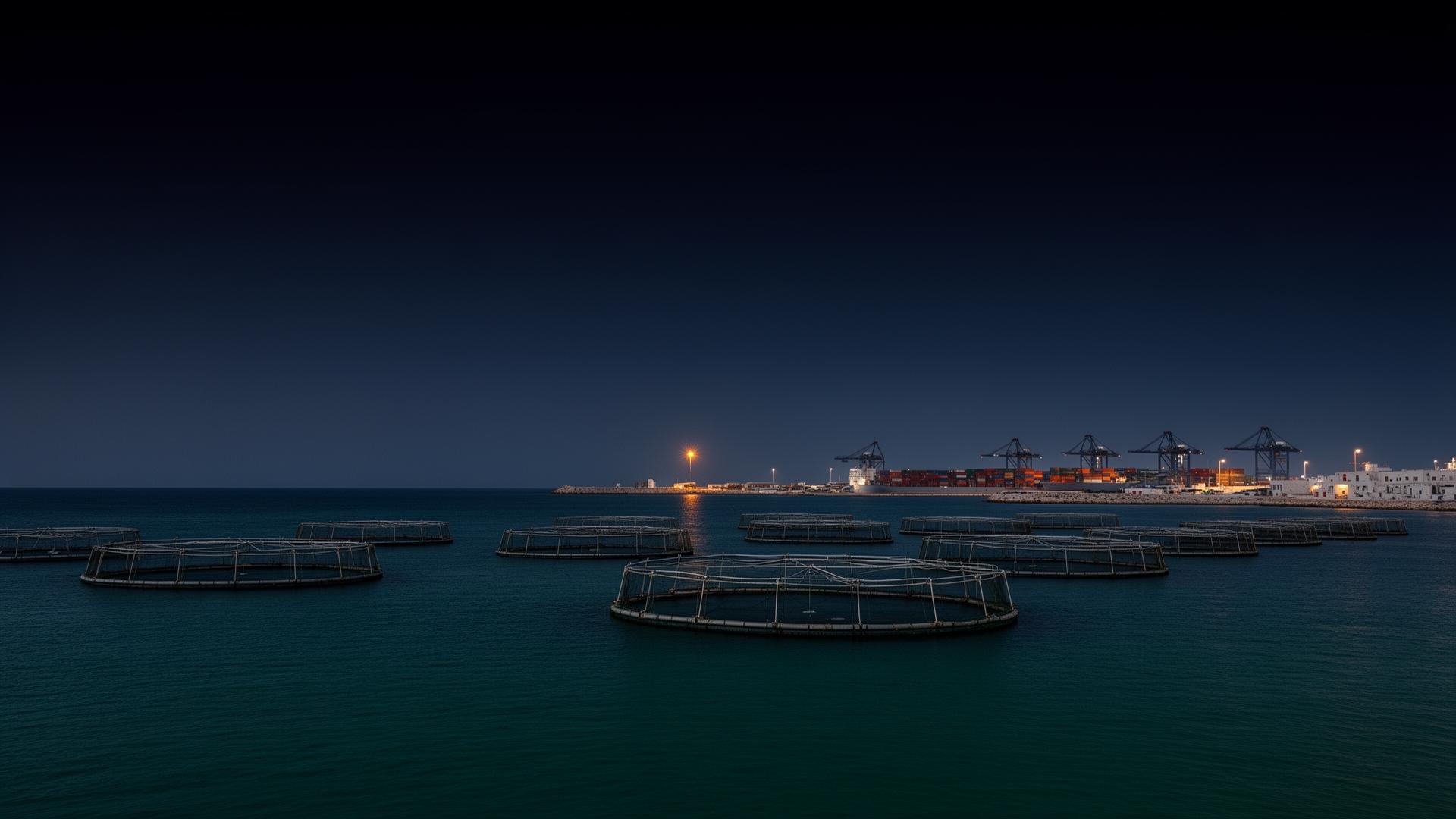
Tunisia · Aquaculture
Blue economy & aquaculture in Tunisia.
A focused read drawn from Saga's full Tunisia country profile — operators, the technical opportunity, and the corridor.
Blue economy & aquaculture
Tunisia has 1,298 km of Mediterranean coastline with historic fishing heritage. Capture fisheries remain significant but are subject to GFCM regulations and overfishing pressure. IUU fishing is a concern but lower than African peers.
Tunisia's aquaculture sector is growing and increasingly differentiated. As of 2024, production reached roughly 23,003 tonnes (up from 21,000 tonnes in 2022), valued at $106 million USD annually. The government has set an ambitious target to grow aquaculture output by 52 percent by 2030, lifting production to roughly 35,000 tonnes. This is a multi-year growth trajectory with real capex momentum.
Farmed species: European sea bass and gilthead sea bream dominate at 96 percent of production; Atlantic bluefin tuna fattening and Mediterranean mussels in Bizerte Lagoon are secondary.
The sector employs roughly 3,000 workers. Approved investment in 2024 was up sevenfold from 2023, with momentum continuing into 2025.
Challenges: 50 percent of fish feed is imported. 80 million fry are sourced abroad. Technology-transfer partnerships with Norwegian or European cage-system and feed-tech suppliers are undersaturated—a clear Saga opportunity.
Port infrastructure: Port of Tunis (Rades) handles roughly 500,000 TEU annually—the largest containerised cargo hub in Tunisia. The Ministry of Transport is assessing digital expansion options for the container terminal. Sfax, Gabes, and Rades ports are being evaluated for digital transformation under Tunisia's 2025–2026 digital-infrastructure programme.
Tunisia ranks third continent-wide and first in North Africa for e-government (UN E-Government Survey 2024), suggesting institutional readiness for port-logistics digitisation.
The aquaculture growth target combined with real capex momentum, import dependency, and lack of Norwegian/Nordic technology partnerships creates a clear opportunity for Saga to position as an aquaculture-tech enabler. Port-logistics digitisation is a secondary angle.
Related — same sector across North Africa