Namibia · Aquaculture
Blue economy & aquaculture in Namibia.
A focused read drawn from Saga's full Namibia country profile — operators, the technical opportunity, and the corridor.
Blue economy & aquaculture
Namibia's hake fishery is among Africa's most productive and most rigorously managed. The total allowable catch for hake is set under sustainable management; it was the first African fishery to receive Marine Stewardship Council certification. The industrial fleet is dominated by large trawlers under long-term access agreements. Foreign companies operate under Namibian licensing and contribute substantially to export revenue. The fishery contributes a meaningful share of GDP and supports many thousands of direct jobs in landing, processing, logistics and supply-chain services. Artisanal and small-scale fishing employs additional thousands.
Lüderitz and Walvis Bay concentrate most of Namibia's seafood-processing facilities. Both are becoming strategic infrastructure assets as oil-and-gas development accelerates. Walvis Bay is the principal deep-water port, handling container, general cargo and bulk commodities. Lüderitz is specialised in fishing, processing and small-vessel maintenance. Both are undergoing expansion to accommodate offshore-energy supply-chain demand.
Aquaculture is emerging at pilot scale. Oyster cultivation in sheltered lagoons exports to Asia and South Africa. More significant is a Norwegian-backed land-based salmon-farming operation under development northwest of Lüderitz, currently in pilot phase with planned commercial-scale capacity at full build-out. Its success depends entirely on Norwegian technology transfer and sustained capital commitment.
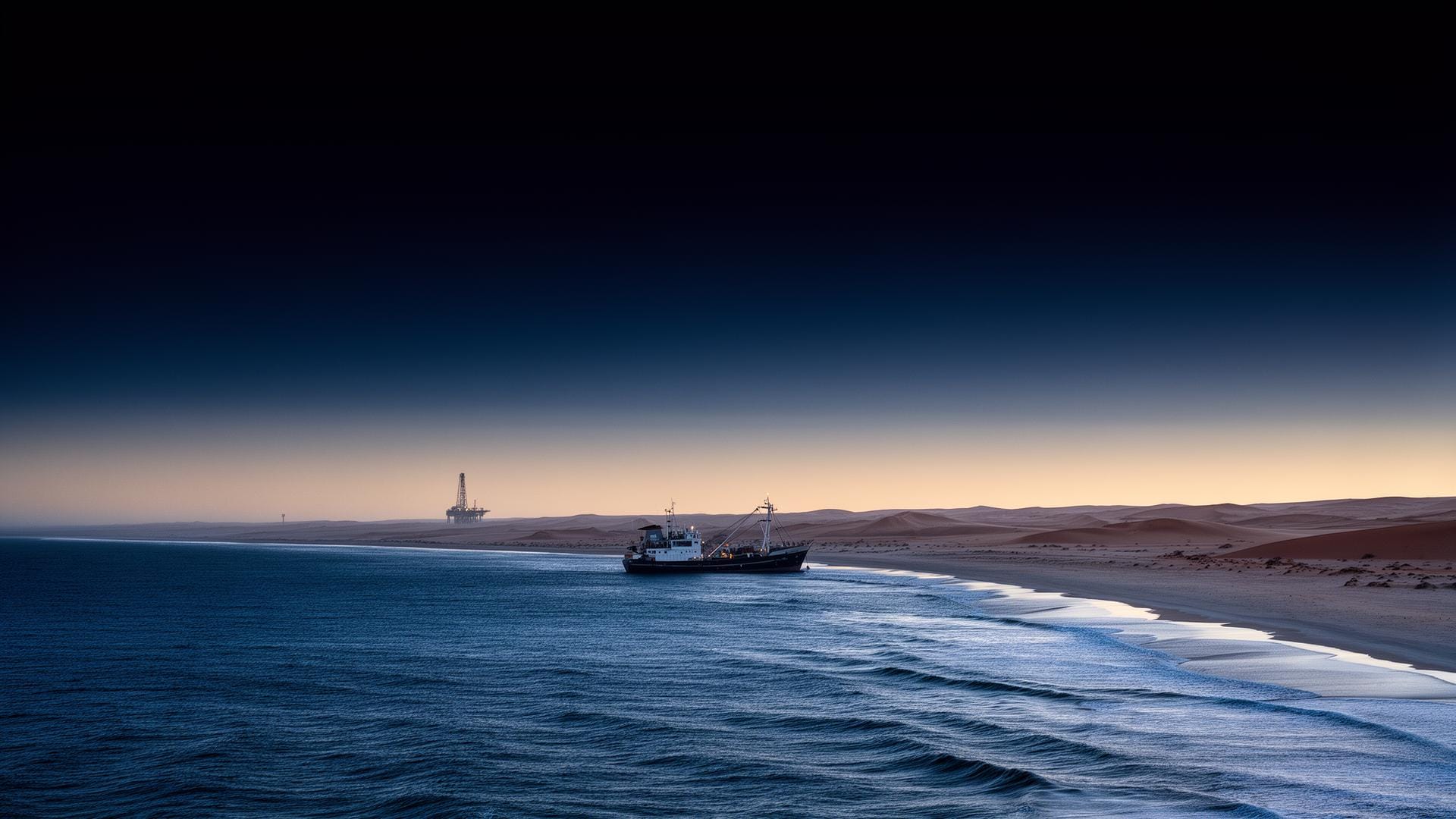
The intersection of oil-and-gas infrastructure and fisheries is now material. Subsea cables, FPSO offloads and rig operations will operate in hake-fishing zones; collision risk, subsea-clearance protocols and fleet coordination will demand active governance. Port modernisation at Walvis Bay and Lüderitz is a 24-to-36-month advisory opportunity for Saga where the principal is moving supply-chain logistics or port-concession structuring. Fisheries surveillance and IUU enforcement are contingent on government capacity and donor funding.